

Music engages an extensive network of auditory, cognitive, motor and emotional processing regions in the brain. It is a powerful tool in the care and rehabilitation of many ageing and neurological diseases. Dr Tepo Sarkamo, Professor of Neuropsychology at the Cognitive Brain Research Unit at the University of Helsinki in Finland.
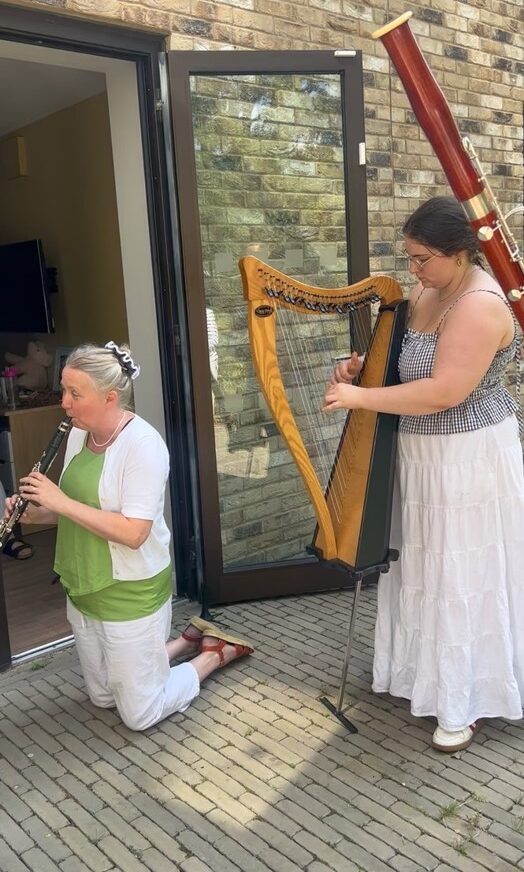
The City of London Sinfonia has partnered with Nightingale Hammerson to bring music directly to the Residents of Hammerson House. For eight weeks, musicians spend one afternoon weekly on Ronson Household, performing for Residents in their own rooms. The programme will return again in the autumn.
It is a beautiful and deeply moving project, created especially for Residents who are room-bound, living with dementia, recovering from stroke or receiving end-of-life and palliative care.
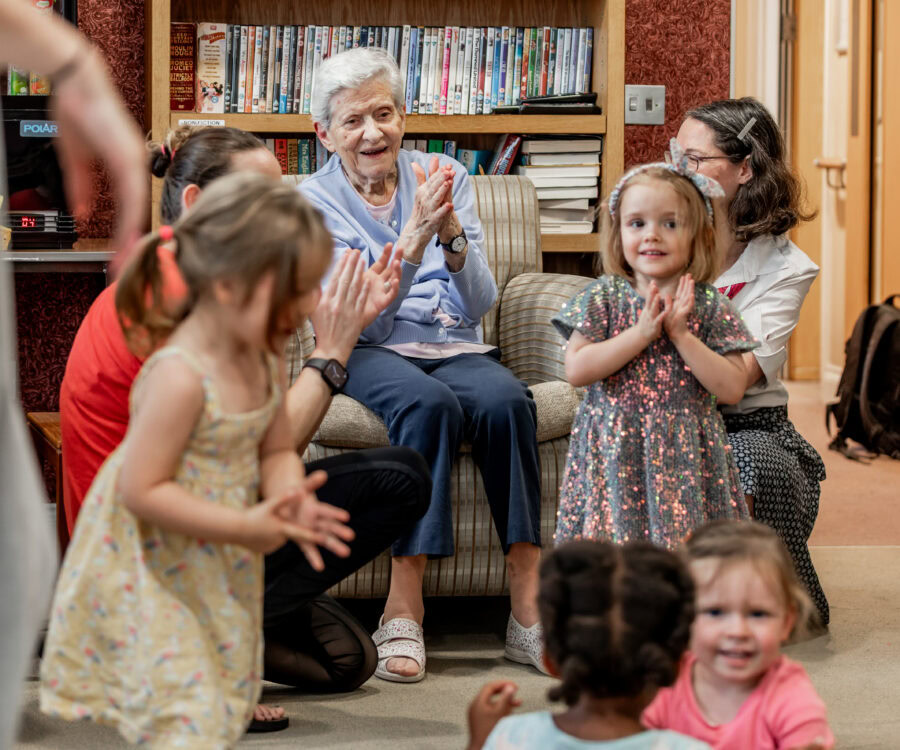
During each visit, the musicians spend time with three or four Residents in their rooms. At the end of the session, Residents who are able to leave their rooms are invited to the lounge, where everyone joins together for an interactive music session using instruments.
According to Renata, Engagement Lead on Ronson Household, “This programme is remarkable. I have seen with my own eyes how people are empowered. The sessions are so emotional.”
One Resident, a former classical pianist living with advanced Parkinson’s, is rarely able to communicate. Her speech is usually little more than a whisper. When the musicians played Beethoven, her favourite composer, she became visibly emotional. She lifted her arm to shake the musician’s hand. When asked why the music had made her cry, she looked up and in a strong, clear voice, said simply, “It’s New York.”
Her love and knowledge of music remained intact. When asked whether she preferred the tuba or the flute, she answered confidently, “The tuba.” As the musicians played Mozart’s Requiem, she smiled and quietly observed, “Too repetitive.” She was not simply listening. She was part of the performance, the fourth musician in the room.
The impact of the music on the Resident was powerful and touching. For a few tender moments, the music reached somewhere words so often cannot. It was an extraordinary reminder that music can reach parts of the brain untouched by illness.
Another Resident, living with severe brain damage after a stroke and whose facial expressions are usually limited, smiled slightly as the music filled her room. She squeezed her brother’s hand. He watched in amazement and commented on the power of the programme.
“The musicians held her attention. She opened her eyes and squeezed my hand whilst they played. It is one of the most heartwarming and amazing things I have witnessed here. The power of music is remarkable. She smiled, she actually smiled. There was a response from my sister and that is so special.”
Fi Johnston, lead musician on the programme, reflected on the unique nature of the project, “Working with people receiving palliative care is something we hadn’t specifically done before coming here. What is so special is meeting people in their own private space, who cannot physically leave their room. These are people at end-of-life, who cannot engage due to illness or who live with profound physical disabilities.”
Before entering each room, the three musicians pause and connect with each other. The fourth musician in the room is always the Resident. The musicians consider whether the person can use language or is asleep, and they improvise the music accordingly. They look at the movement of the fingers, their breath, a breeze in the room. They bring texture, movement and sound into the Resident’s space to offer something calming and supportive.
Partnership lies at the very heart of this project and magical moments appear every time. Relatives and care teams discover new ways of connecting with people who may no longer be able to communicate in conventional ways. Music becomes a shared language, creating connections where words sometimes cannot.
As the sweet sound of the clarinet echoed gently around one room, a Resident nodded in time with the music and squeezed the musician’s fingers. She smiled and lifted her hand to her eye to wipe away a tear, a movement that is usually incredibly challenging for her. The musicians softly whispered her name, weaving it into their improvisation. It was another beautiful moment.
A Resident, confined to her room after breaking both legs, asked if the musicians would play a special song. Curious about the small harp, she asked how it worked and the musicians happily explained before performing for her.
Mannya, Household Manager of Ronson, said, “The one-to-one sessions are particularly beneficial for those who are more isolated. This is an exceptional project. You see Residents opening their eyes, becoming engaged and even uttering a few words. It is truly incredible to witness.”
The impact lasts long after the musicians leave. Residents appear more settled, more peaceful. The programme also transforms everyone else in the room. As one bassoonist explained, “I witness the impact on the whole space. I see carers smiling and dancing, grandchildren engaging with grandparents. The impact on the teams and families as well as the Resident is powerful. It is a positive and uplifting experience for everyone.”
To see Residents living with cognitive decline suddenly smile, sing or even utter a “Thank you,” is profoundly moving. Music unlocks something deep within the mind. It reaches beyond illness, beyond memory loss and beyond physical limitations.
Music builds a rapport, a connection between people and sometimes, the most powerful conversations happen without words at all.